Local resources. Shared prosperity.Abuja, Nigeria · Innovation & Investment
Premium Blue EconomyINNOVATION & INVESTMENT
Ocean & water

Fisheries & aquaculture

Capture value across the aquatic food system.

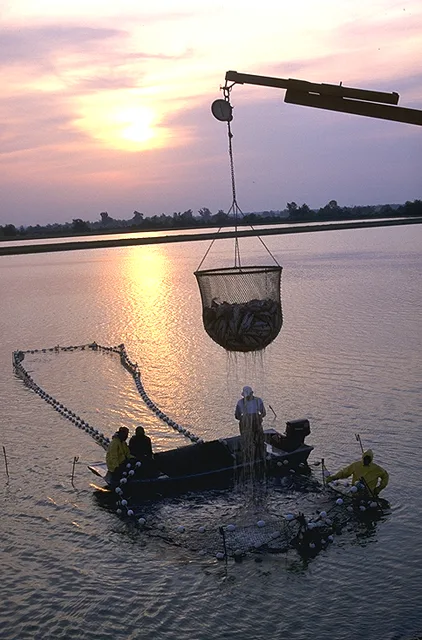
Workers lifting a net during catfish harvesting
Opportunity design, not an investment promise. These are Nigeria-focused candidate pathways. Verify site conditions, permissions, customer requirements and operating economics before implementation.

From local resource to useful service

For Nigerian catfish and other locally suitable aquatic species, the opportunity is a coordinated food system rather than fish ponds alone. Seed quality, feed, water, disease prevention, processing and reliable sales must work together. Proposed residue outlets should follow the requirements of a named customer.

Explore every pathway

Choose a pathway for its process, customers, evidence requirements and a focused discussion.

Resource → process → qualified customer

Hatcheries

How the pathway works

Select suitable broodstock, manage spawning and nursery water, grade juveniles and plan delivery to farms.

Users and possible revenue model

Farmers buy healthy, traceable seed matched to production plans.

Specifications and evidence before investment

Verify species identity, survival, disease control, genetics management and transport conditions.

Open this opportunity →
Resource → process → qualified customer

Fish farming

How the pathway works

Match stocking and feeding to the water system, harvest schedule and buyer size requirements.

Users and possible revenue model

Fresh-fish buyers, processors and food-service operators can provide offtake.

Specifications and evidence before investment

Test water, document feed conversion and survival, manage effluent and model feed-price and power risks.

Open this opportunity →
Resource → process → qualified customer

Feed production

How the pathway works

Formulate and process verified ingredients for the target species and growth stage.

Users and possible revenue model

Farms may buy feed only after repeatable quality and performance trials.

Specifications and evidence before investment

Analyse nutrients, contaminants, storage stability and pellet properties; residues are not automatically safe feed.

Open this opportunity →
Resource → process → qualified customer

Fish processing

How the pathway works

Grade, clean, chill, smoke or dry fish under a defined hygiene and traceability system.

Users and possible revenue model

Wholesalers, retailers and institutional caterers need consistent product and delivery.

Specifications and evidence before investment

Validate shelf life, packaging, temperature control and smoke-related contamination risk for the process used.

Open this opportunity →
Resource → process → qualified customer

Fish oils

How the pathway works

Segregate appropriate fresh processing residues and assess recovery, stabilisation and refining.

Users and possible revenue model

Industrial or feed customers may qualify an oil; food or nutraceutical use is a separate higher-evidence route.

Specifications and evidence before investment

Measure oxidation, contaminants, composition, yield and storage. Do not market crude recovered oil as a health supplement.

Open this opportunity →
Resource → process → qualified customer

Shell-derived materials

How the pathway works

Where an actual shellfish-processing stream exists, assess shell cleaning and recovery of mineral or chitin-derived products.

Users and possible revenue model

Materials formulators and qualified industrial customers could request samples.

Specifications and evidence before investment

Verify species, shell supply, chemical use, effluent, purity and buyer specification; this does not apply to catfish residues.

Open this opportunity →
Start with evidence

Three practical pilot designs

Catfish supply-chain baseline

Interview seed, feed, farm and market operators and measure constraints before choosing a shared facility.

Processing loss reduction

Trial hygienic handling and appropriate preservation, comparing saleable yield and energy use.

Residue qualification

Send segregated samples to a laboratory and potential buyer before investing in extraction equipment.

Safeguards and operating responsibilities

  • Prevent escape, disease transfer and untreated discharge.
  • Maintain food hygiene and worker safety.
  • Verify feed and ingredient legality and quality.
  • Avoid expansion unsupported by water availability or buyer demand.

Measure before scaling

  • Survival and feed conversion
  • Saleable yield
  • Water and energy per output
  • Verified loss reduction
  • Margin with observed feed and sales prices

Build the commercial case

Confirm the customer specification and sample acceptance first. Obtain site-specific capital and operating quotations, including feedstock, labour, energy, maintenance, logistics, testing, insurance, permissions and residuals. Model working capital and downside scenarios using documented assumptions. Shared inputs or by-products count as revenue only when safe, deliverable and accepted by a customer.

Connect this portfolio

Assess shared utilities, services and qualified material exchanges across these related sectors. Record allocation so the same resource or benefit is not counted twice.

Evidence and further reading

The linked sources inform the sector’s general technical or development basis. Nigeria-specific pilots and business models on this page are proposed designs, not endorsed projects, verified returns or commitments by the source organisations.